For much of the last decade, artificial intelligence has been operating at a distance: in massive data centers, supported by large cloud infrastructures, accessed through APIs and dashboards. It worked well when intelligence could afford to wait. Increasingly, it cannot be.
Today, AI is expected to provide instant responses, work successfully in imperfect conditions, and be responsive to expectations around privacy and control. As a result, intelligence must propel itself closer to where life happens, into devices, machines, and across local infrastructure. As such, we are witnessing the rise of Edge AI, and by 2026, it is quietly becoming foundational.
You can see examples of these new approaches in everyday moments. A wearable device that notices subtle changes in heart rhythm and alerts before symptoms appear. Industrial robots that instantly react to unexpected obstacles before checking back with a remote server. Systems that continue to operate even when network connectivity is lost. These are not just examples of what may happen in the future but are practical solutions to current constraints.
What Is Edge AI?
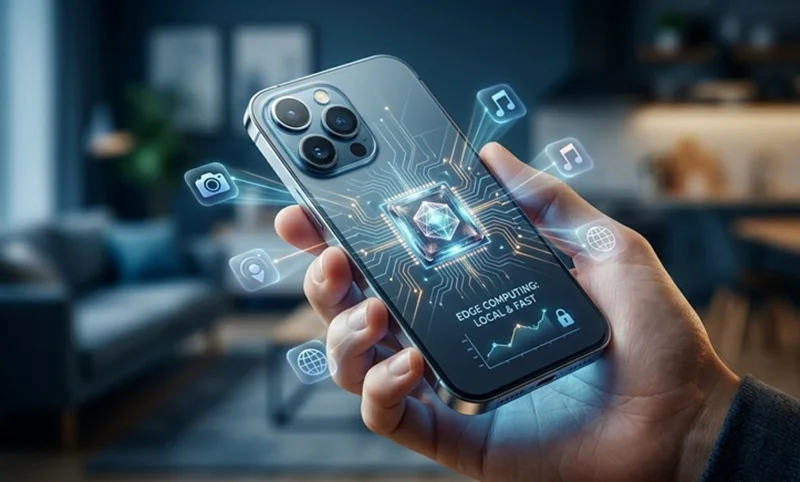
At its core, Edge AI involves deploying AI algorithms directly on devices like smartphones, cameras, sensors, gateways, or on-premises systems instead of transferring all data to centralized cloud platforms for processing.
The difference may sound technical, but the outcomes are immediate. Cloud-based AI requires constant connectivity to a centralized data center, which introduces delays and cost. On the other hand, Edge AI processes data close to its source, and systems remain functional even in disconnected environments.
In other words, Edge AI allows intelligence to act immediately instead of waiting.
Why Edge AI Matters
This shift is being forced on organizations because of four factors:
- First, speed has become critical. In applications such as autonomous systems, healthcare monitoring, robotics, and industrial automation, even small delays can have colossal consequences. Edge AI eliminates the latency introduced by round trips to the cloud, enabling real-time responses where timing truly matters.
- Second, privacy and regulation are no longer secondary concerns. Data protection frameworks such as GDPR, CCPA, and several national data sovereignty legislations are imposing highly strict limitations on the handling of sensitive information, Health data, biometric identifiers, proprietary, and industrial information need to remain local. Edge AI enables organizations to comply with these requirements by minimizing unnecessary data movement.
- Third, cost and efficiency are under pressure. It is costly and energy-consuming to send massive amounts of raw data to the cloud. Local data processing can significantly lower the need for bandwidth and thus reduce operational costs in most cases without losing accuracy or functionality.
- Finally, resilience has become a strategic priority. Systems requiring 100% connectivity are fragile by nature. Edge AI provides the ability to continue performing critical functions if there is an unreliable or unavailable network. These factors are redefining how organizations approach intelligence.
Together, these realities are reshaping how organizations think about intelligence.
Industry Impact in Practice
Edge AI is already making a measurable difference across industries:
1) Manufacturing:
In manufacturing, the floor AI systems that are based locally keep track of the machine conditions by analyzing the performance of the equipment. They can detect problems automatically, which leads to minimizing downtime and making the work environment faster and safer.
2) Healthcare:
In healthcare, devices integrated with edge computing continuously gather patients’ health data, allowing healthcare professionals to intervene more quickly while preserving privacy.
3) Retail:
In retail, Edge AI provides in-store analytics that optimize inventory and provide a more personalized shopping experience without relying on centralized data collection.
4) Telecommunications:
In telecommunications, Edge AI improves performance, security, and scalability as connected devices multiply.
One of the most remarkable aspects of this transition is not only how diverse the applications of Edge AI have become but how established they are as part of the everyday operations of those industries, rather than as experimental pilots.
What Makes Edge AI Possible
Edge AI has permeated all facets of industry and its influence is palpable. Specialized edge hardware, including NPUs, ASICs, and neuromorphic processors, allow for running AI inference efficiently within very limited power and thermal constraints. More efficient model designs, such as state-space models and small language models, enable running smart applications even on very limited devices.
Edge-to-cloud orchestration allows local autonomy to be complemented with centralized oversight, training, and governance. Advances in connectivity, especially with 5G and upcoming 6G networks, will make edge intelligence accessible at various distributed locations. As one, these factors help to implement intelligence in a way that is local by default and centralized only when required.
Challenges to Address
Edge AI also faces some challenges. Edge devices are limited in memory, power, and cooling. It is complicated to manage the updates of models and security across large, distributed fleets. Hardware and software diversity are also bringing interoperability issues.
These are real issues, but they are solvable. They are just a part of the transition from pilot to production of technology.
Looking Ahead
As we move toward 2030, Edge AI ecosystems will become more prevalent. We will see AI more deeply integrated with networking and security; intelligence systems gaining more independence; and models can learn and adapt on the spot without the need for centralized retraining all the time.
The cloud will still play a vital role, especially in training and coordination — but inference or intelligence, will increasingly live at the edge.
Why This Matters
Edge AI matters because it brings intelligence closer to human reality. It aligns technology with limitations of time, energy, privacy, and trust. Above all, they unlock systems that feel less remote and more responsive, powering technology that coexists with the world instead of standing apart from it.
The future of AI will not be defined by the size of models or the scale of data centers. It will be defined by how seamless intelligence integrates into everyday environments, quietly, reliably, and when it’s most needed.
That is the real edge.
About the Author