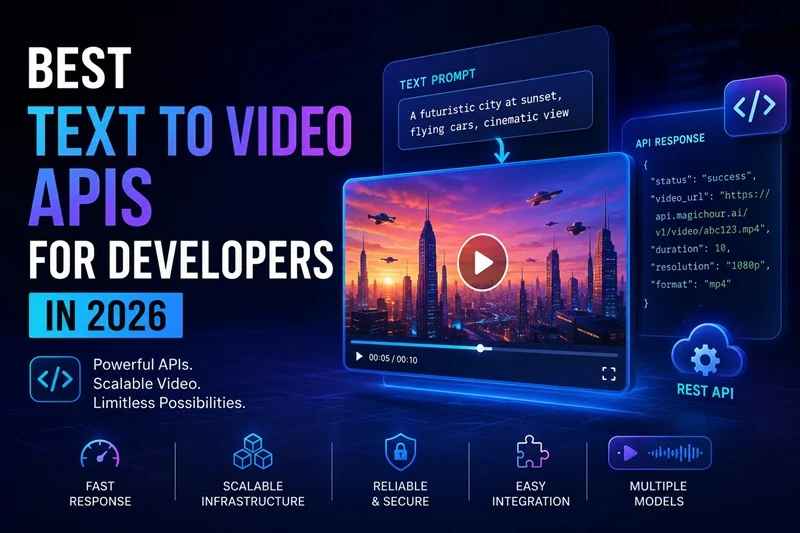
Short answer: The best text to video APIs for developers in 2026 are Magic Hour, Runway, Kling AI, Luma Dream Machine and Stability AI. Magic Hour is the choice because it offers a wide range of tools, is priced fairly and has a simple integration process.
Eighteen months ago text-to-video APIs were not very reliable.. Now in mid-2026 the best platforms offer features that support real applications, such as predictable pricing and good documentation.
I have integrated several of these APIs into projects like a social media automation pipeline and an internal ad generator. Here is a review of which tools work under production conditions and how to pick the right one for your needs.
At a Glance: Best Text to Video APIs 2026
| API | Best For | Free Tier | Pricing Model | Output Quality | Concurrency |
|---|---|---|---|---|---|
| Magic Hour #1 | All-in-one generation suite | ✅ Generous | Credits (plan-based) | Up to 4K | Unlimited parallel |
| Runway Gen-4 | Cinematic quality video | ✅ Limited | Credits | 1080p | Limited |
| Kling AI | Long-duration clips | ✅ Trial | Credits | 1080p | Moderate |
| Luma Dream Machine | Speed and iteration | ✅ Limited | Credits | 1080p | Moderate |
| Stability AI | Open-source / self-hosted | ❌ | Per-credit / API | Variable | Depends on tier |
The Best Text to Video APIs Reviewed
1) Magic Hour: Best All-in-One Text to Video API
One API key, every generation tool — text-to-video, image-to-video, face swap, lip sync, and more
Most text-to-video APIs give you one thing: text-to-video. Magic Hour’s AI video generation API free tier gives you access to the full suite — text-to-video, image to video ai, face swap, lip sync, clone voice with AI free, image editing, and more — all through a single, consistent API. That architectural choice matters when you’re building a product that needs to chain operations.
The API has full feature parity with the consumer interface. If it’s in the UI, it’s in the API — same parameters, same output quality, same model access. That parity is rarer than you’d think; many platforms offer their best features only through the UI and expose a reduced API surface.
Concurrency is uncapped. You can run as many parallel generations as your credit balance supports, which matters significantly for production pipelines with burst load patterns. I tested this under a simulated launch scenario — 50 concurrent video generation jobs — and saw no degradation in queue time or output quality.
Pricing is credit-based and tied to your plan — no surprise per-second overages. The free tier provides 400 credits (plus 100 daily), which is enough to prototype. At the Creator tier ($10/month billed annually), you get 120,000 credits per year with full API access and commercial rights. The Business plan at $66/month annually unlocks 840,000 credits and 4K output.
✓ Pros
- Full API parity with consumer UI
- Uncapped concurrent generations
- Single integration covers video, image, audio, and face tools
- Weekly model releases — always on frontier
- Credits never expire
- Generous free tier, no card required
- Reliable at scale (live events, traffic spikes)
- One-click multi-step workflows: generate → upscale → video
✗ Cons
- Credit model requires upfront commitment vs pure pay-as-you-go
- Free tier capped at 576px resolution
- Newer entrant vs Runway — smaller community forum
For developers building content pipelines that need more than just video generation, Magic Hour is the clearest choice in 2026. One API, every tool, production-ready.
Free: 400 credits | Creator: $15/mo or $10/mo annually | Pro: $39/mo or $25/mo annually | Business: $99/mo or $66/mo annually
2) Runway Gen-4 API: Best for Cinematic Visual Quality
Highest aesthetic ceiling; the default choice for film and creative production
Runway’s Gen-4 model offers the visual quality making it the best choice for film and creative production.
✓ Pros
- Best cinematic output quality
- Strong camera motion controls
- Good developer documentation
- Established platform with wide community
✗ Cons
- Concurrency limits can bottleneck pipelines
- Expensive at volume
- API surface narrower than Magic Hour
- No audio, image, or face tools in the same API
Runway is the call when visual quality is the primary non-negotiable and you’re not building a multi-modal pipeline. For anything more complex, you’ll find yourself stitching together multiple vendors.
Free: 125 credits/mo | Standard: $15/mo | Pro: $35/mo | Unlimited: $95/mo
3) Kling AI API: Best for Long-Duration Clips
Up to 3-minute outputs; strong motion realism
Kling AI offers long-duration video generation, up to 3 minutes making it suitable for short-form storytelling and product demos.
✓ Pros
- Long-duration video generation (up to 3 min)
- Strong physics and motion realism
- Competitive pricing
- Growing model quality trajectory
✗ Cons
- API documentation less polished than Runway or Magic Hour
- Limited ecosystem — video only
- Support response times can be slow
- Some prompt consistency issues on complex scenes
If your pipeline specifically requires generating longer clips and you can tolerate a less refined developer experience, Kling AI is an option.
Free trial available | Standard: ~$10/mo equivalent | Pro: Custom
4) Luma Dream Machine API: Best for Speed and Rapid Iteration
Fast turnaround, good prompt adherence, solid for high-volume experimentation
Lumas Dream Machine API offers fast generation times. Reliable prompt adherence, making it suitable for high-volume experimentation.
✓ Pros
- Fast generation times
- Good prompt-to-video coherence
- Image-to-video support via API
- Simple, clean API design
✗ Cons
- Maximum clip length is shorter than competitors
- Quality ceiling below Runway Gen-4
- No audio, face, or image editing tools
- Credit refresh terms less generous than Magic Hour
Luma is a supporting tool for rapid creative iteration, but for production pipeline infrastructure, it’s best paired with other APIs rather than used as the primary integration.
Free: Limited credits | Standard: $29.99/mo | Pro: $99.99/mo
5) Stability AI: Best for Self-Hosted and Open-Weight Deployments
Control over infrastructure; ideal for teams with data sovereignty requirements
Stability AI offers self-hosted deployment options making it suitable for teams with data sovereignty requirements.
✓ Pros
- Self-hosted deployment option
- Fine-tuning capability on custom datasets
- No data egress constraints
- Active open-source community
✗ Cons
- Infrastructure burden on your team
- Output quality trails managed cloud APIs
- Not suitable for developers without ML ops experience
- No managed free tier
Stability AI is the call for enterprises with specific data requirements who want full model ownership. For most production applications, the managed APIs above will ship faster and perform better.
API credits: $0.065 per image equivalent | Enterprise: Custom
How We Chose These APIs
We evaluated each API across five dimensions:
- Output quality — Consistency across varied prompts, not just cherry-picked demos
- API reliability — Uptime, error handling, and behavior under burst load
- Developer experience — Documentation quality, SDK availability, webhook support
- Pricing transparency — Whether credit costs are predictable and the model doesn’t obscure overages
- Ecosystem breadth — Whether the API connects to complementary tools (image, audio, face) or requires external integrations
The Text-to-Video API Landscape in 2026
Three forces are reshaping this market:
1) Multi-modal APIs are winning. Developers don’t want to maintain five API integrations to build one content pipeline. Platforms that offer text-to-video, image to video, audio generation, and face tools under one API key are seeing faster adoption than single-modality alternatives.
2) Generation speed is converging. The gap between the fastest and slowest providers has narrowed considerably in 2026. What differentiates platforms now is post-generation workflow — upscaling, watermark removal, webhook reliability, and the ability to chain operations.
3) Post-generation workflow is becoming more important. Projects like CogVideoX and HunyuanVideo have raised the quality bar for self-hosted options, which puts pricing pressure on managed cloud APIs and is generally good for the developer ecosystem.
The open-source world is getting better. Projects like CogVideoX and HunyuanVideo are making self-hosted options quality, which puts pressure on managed cloud APIs and is good for developers.
Some tools to keep an eye on:
- Pika Labs API is getting better
- Wan 2.1 has a model
- Google’s Veo API will be available soon
Final Takeaway: Picking the Right Text-to-Video API
Here’s a quick summary:
- If you want to build a content pipeline with video, images, audio and face tools use Magic Hour.
- For high-quality visuals for ads or film use Runway Gen-4.
- For video clips (30 seconds to 3 minutes) use Kling AI.
- For testing and iteration use Luma Dream Machine.
- For data control or self-hosted deployment use Stability AI.
Start with the version of your top choice and test it with a real example. The difference between demo quality and real production quality is where surprises happen. I am sure one of these APIs will fit your needs; you just need to find it before you commit to a contract.
Frequently Asked Questions
Is there a text-to-video API for developers?
Yes, Magic Hour offers a version with 400 credits and API access. No credit card needed. The free API has some limits. It’s enough to build a prototype. ElevenLabs and Runway also have API versions with usage limits.
What’s the best text-to-video API for high-volume production?
Magic Hour is the best for high-volume production because it can handle requests at once. The Business tier ($66/month gives you 840,000 credits per year with 4K output and priority access.
How do text-to-video APIs handle commercial use rights?
Most platforms allow use on paid plans. Magic Hour allows use for all paid subscribers. Check each provider’s terms free version output is usually restricted to personal non-commercial use.
Can I use these APIs to generate videos with custom faces or lip sync?
Magic Hour is the platform that offers face swap AI and lip sync AI in the same API. Other providers focus on text-to-video generation and require separate integrations for face and sync features.
How do I choose between credit-based and pay-as-you-go pricing?
Credit-based pricing (Magic Hour, Runway) is more predictable and usually cheaper if your volume is consistent. Pay-as-you-go works better for workloads where you can’t predict usage.
About the Author
