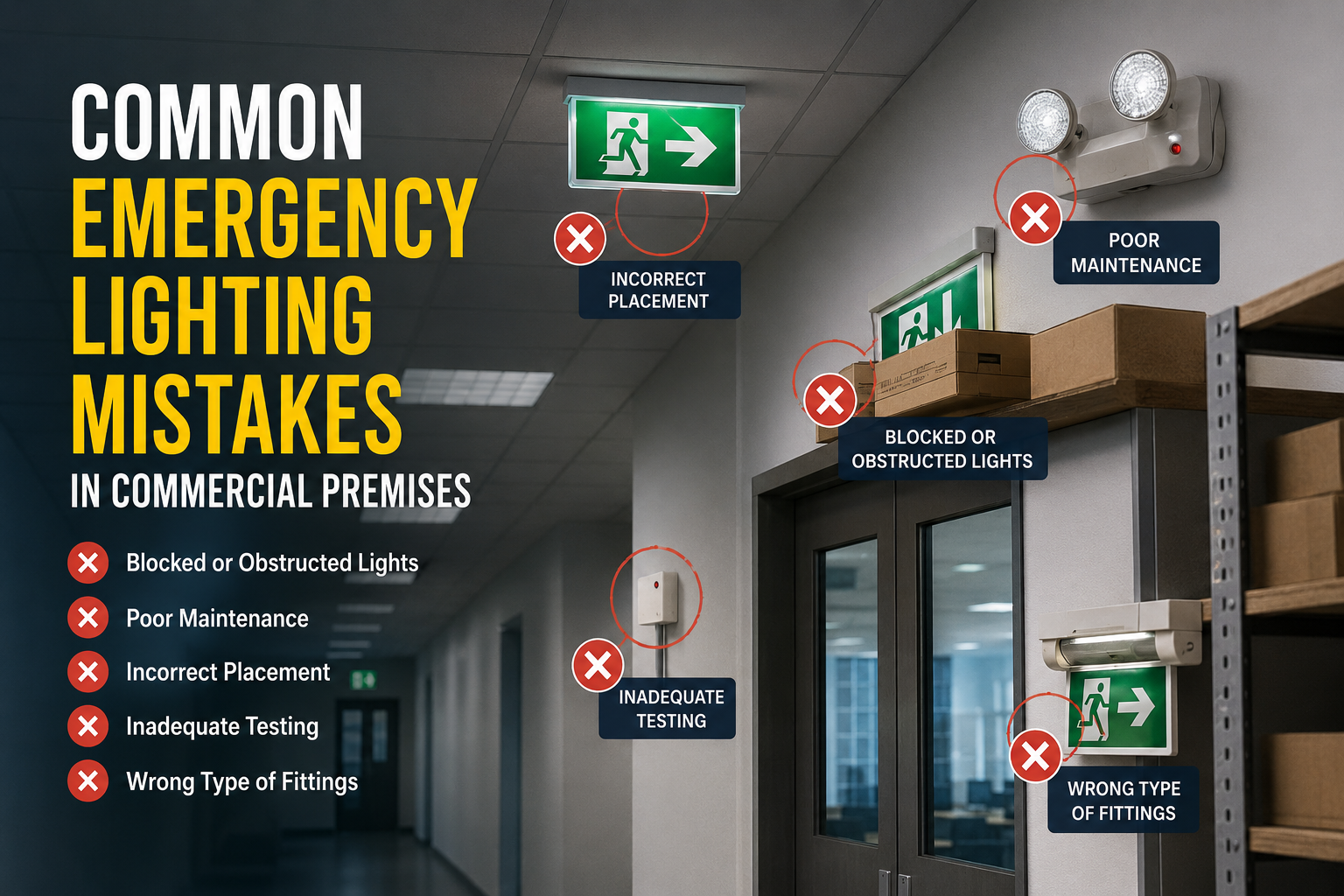
Why Small Mistakes Can Create Serious Gaps?
Emergency lighting is designed to support safe movement when normal lighting fails. In a commercial building, that failure may happen during a fire, electrical fault or local power cut. People must still be able to see the escape route, follow exit signs and avoid obstacles. A system that is incomplete or poorly maintained may not provide enough useful light when it is needed.
Many emergency lighting problems are not caused by a complete lack of fittings. They develop because the building has changed, tests have been missed or products have been installed without enough attention to the layout. These issues can affect offices, shops, warehouses, HMOs, leisure facilities and hospitality premises. The responsible person should use the fire risk assessment to review the system and arrange competent advice where needed. The following mistakes are common and can often be prevented through better planning and maintenance.
Using One Type of Fitting Everywhere
Commercial premises can require several types of Emergency Lighting, including exit signs, bulkheads, downlights, battens, twin spots and emergency panels. Light Hub Direct stocks options for different building areas, but the correct choice depends on the purpose and position of each fitting.
An illuminated exit sign identifies a route or final exit, but it may not provide enough light across the floor. A twin spot can deliver strong output in a large industrial area, yet it may be unsuitable for a low office corridor. Recessed emergency downlights can provide a discreet finish, while robust IP-rated bulkheads may be more practical in stairwells, car parks or service areas.
A proper design considers escape-route coverage, open areas, fire equipment points, changes of direction and high-risk tasks. Selecting one product for the whole site because it is easy to order can leave some areas overlit and others poorly covered.
Failing to Update the Layout After Alterations
Office partitions, warehouse racking, display units and temporary structures can all block light. A fitting that once covered an open room may become ineffective when a tall partition is added beneath it. Exit signs may also become difficult to see after doors, shelving or signage are moved.
Refurbishment plans should include a review of emergency lighting and fire escape signage. This applies even when the electrical system itself is not being replaced. A new meeting room, mezzanine floor or storage area can change the escape route and create new points that need illumination.
After alterations, the responsible person should check the fire risk assessment and arrange updates where required. It is much easier to add wiring and fittings during the main works than after ceilings and finishes have been completed.
Treating a Glowing Indicator as Proof the Unit Works
Many emergency fittings have a small indicator showing that the battery is charging. This does not prove the lamp will operate for the required period during a mains failure. Batteries lose capacity, internal components fail and lamps can develop faults that are not visible during normal use.
Functional and duration tests are needed to confirm operation. The testing schedule should follow the relevant standards, fire safety arrangements and manufacturer guidance. Results need to be recorded so repeated faults and overdue repairs can be identified.
Self-test products can make fault detection easier, particularly across larger sites, but indicators still need to be checked and any reported issue must be investigated. Automated testing does not remove the need for inspection, maintenance or accurate records.
Ignoring External Escape Routes
The final exit door is not always the end of the escape route. People may need to cross a rear yard, external stair, passageway or car park before reaching a place of safety. If these areas depend on normal lighting, a power failure may leave occupants in darkness after they leave the building.
The fire risk assessment should consider external routes where illumination is needed. Outdoor emergency fittings require a suitable IP rating and must be positioned to cope with weather, mounting height and possible damage. Glare should also be controlled so people can see steps, kerbs and route changes clearly.
External lights are easy to overlook because routine tests are often completed during daylight. Testing arrangements should make it possible to confirm that these fittings operate and provide useful coverage.
Mixing Incompatible Parts or Unclear Operating Modes
Replacement batteries, drivers and control gear need to be compatible with the fitting. Using an unsuitable component may affect charging, duration or reliability. Emergency conversion packs should only be used with products and light sources for which they are designed.
Maintained and non-maintained operation can also cause confusion. A maintained fitting remains lit during normal conditions, while a non-maintained fitting normally activates only when the supply fails. The mode required depends on the location and fire safety design. Some premises accidentally leave a maintained fitting switched off or wire a product in a way that prevents correct emergency operation.
A competent electrician should follow the product instructions and verify the supply arrangement. Labels, circuit information and test records can make future maintenance much easier.
Buying Replacements Without Checking the Specification
When a fitting fails, it may be tempting to order the closest-looking replacement. However, the new unit may have a different emergency duration, lumen output, viewing distance, IP rating or self-test function. These differences can affect the performance of the system.
Light Hub Direct provides product details for its emergency lighting range, allowing buyers to compare key features before ordering. For urgent maintenance, free next-day UK shipping is available on qualifying orders over £50 under the retailer’s current delivery terms.
The safest approach is to keep an asset list that records product type, location, test results and replacement details. Combined with regular review by competent people, this reduces the chance that gradual changes will weaken the system. Emergency lighting should be managed as active safety equipment, not as a set of fittings that can be forgotten once installed.
About the Author