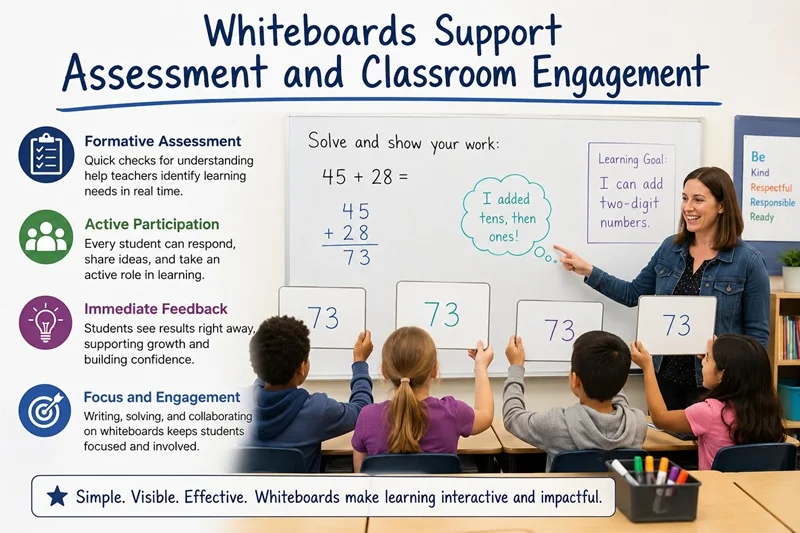
Teachers are constantly looking for ways to increase participation and check understanding during lessons. One of the simplest and most effective tools available is the individual whiteboard. A4 whiteboards are used in schools throughout the UK because they encourage active learning while providing teachers with immediate insight into pupil understanding. Their versatility makes them suitable for all age groups and a wide variety of subjects.
Why Schools Continue to Invest in A4 Whiteboards
When purchasing A4 Whiteboards, schools are investing in a resource that supports teaching across multiple curriculum areas. Unlike single use materials, whiteboards can be used repeatedly throughout the academic year.
Teachers value whiteboards because they create opportunities for whole class participation. Every pupil can respond to questions at the same time, allowing teachers to gather instant feedback without relying solely on verbal responses.
Inclasstomorrow supplies educational resources designed for UK classrooms, including whiteboards that are suitable for daily school use.
Immediate Feedback for Teachers
One of the key advantages of whiteboards is the speed at which teachers can assess understanding. During a lesson, pupils can write answers and hold up their boards for review.
This allows teachers to identify gaps in knowledge immediately. If several pupils provide incorrect answers, additional explanation can be given before the lesson progresses.
Without whiteboards, these misconceptions might not become apparent until books are marked later, potentially slowing progress.
Encouraging Participation from All Pupils
Not every pupil feels comfortable answering questions aloud. Some may lack confidence, while others simply prefer to think through their answers privately.
Whiteboards provide an alternative way for pupils to contribute. Because everyone is responding simultaneously, pupils often feel less exposed and more willing to participate.
This can be particularly valuable for quieter pupils who may have strong understanding but rarely volunteer answers during class discussions.
Supporting Retrieval Practice
Retrieval practice has become a popular teaching strategy in UK schools. It involves revisiting previously taught material to strengthen memory and long term retention.
Whiteboards are ideal for retrieval activities. Teachers can ask quick questions at the start of lessons and receive responses from the entire class within minutes.
These activities require minimal preparation and provide valuable information about how well pupils have retained prior learning.
Useful Across the Curriculum
The flexibility of whiteboards makes them suitable for many different subjects.
In English lessons, pupils can practise spelling, grammar and sentence writing. Maths teachers can use them for mental arithmetic and problem solving. Science lessons can include predictions, diagrams and quick knowledge checks.
Even creative subjects can benefit. Pupils can sketch ideas, plan projects and brainstorm concepts before producing more detailed work elsewhere.
Reducing Administrative Work
Whiteboards can also save teachers time. Not every activity needs to be recorded permanently, particularly when the purpose is practice or discussion.
Instead of printing worksheets for short exercises, teachers can use whiteboards and erase responses once activities are complete. This reduces photocopying requirements and lowers paper consumption.
Schools seeking to manage budgets effectively often appreciate the long term value that reusable resources provide.
Promoting Collaborative Learning
Whiteboards can also be used in pairs or small groups. Pupils can work together to solve problems, discuss answers and share ideas before presenting their conclusions.
This collaborative approach supports communication skills and encourages pupils to explain their thinking. Teachers can observe group discussions and provide guidance where necessary.
The combination of collaboration and instant feedback makes whiteboards particularly effective in active learning environments.
Conclusion
A4 whiteboards remain an important classroom resource because they support assessment, participation and engagement. Their flexibility allows teachers to adapt activities quickly while encouraging all pupils to take part in learning.
For UK schools looking to invest in practical classroom resources, quality whiteboards offer long term value and wide ranging educational benefits. Inclasstomorrow provides whiteboards and other school essentials that help teachers create interactive and effective learning environments.
About the Author


